
AEM development · Surry Hills, Sydney
AEM your authors actually want to use
AEM can do almost anything, which is why so many implementations end up harder to run than they should be. Tonic is a full service independent agency in Sydney specialising in Adobe Experience Manager (AEM) development, with enterprise sites built and supported for LG. Our senior developers build, migrate, upgrade and support AEM Sites, with components and templates your authors can use without calling a developer.
- AEM Sites development and ongoing support for LG
- Migrations to AEM as a Cloud Service, planned and tested before go-live
- Adobe Analytics, Target and Commerce integrations, plus headless delivery
Prefer to talk? Call 1300 974 864

AEM platforms built to scale
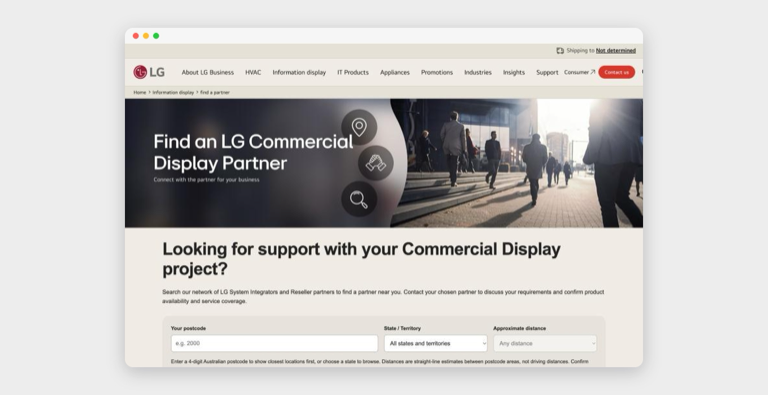
LG (AEM Sites)
Custom AEM Sites pages for LG Australia, including a partner finder.
Read the case study: LG (AEM Sites) →
AEM services, from first build to the next upgrade
AEM Sites builds and implementations
New AEM Sites platforms, from solution architecture to launch, with a component library and templates built around how your team publishes.
AEM as a Cloud Service upgrades
Moves from AEM 6.x on-premise or Adobe Managed Services to AEM as a Cloud Service, with code refactoring, content transfer and a tested cutover.
Components authors can use
Reusable, accessible components and editable templates, so marketing can build and change pages without raising a ticket.
Migrations to AEM
Content, assets and URLs moved from Sitecore or a legacy CMS into AEM, with redirect mapping and validation.
Experience design and front end
Page and journey design built as a fast, accessible front end that works with AEM authoring, not against it.
Headless and hybrid delivery
Content Fragments and GraphQL for apps, kiosks and other channels, alongside traditional AEM pages.
Multi-site and multi-language
Multi Site Manager, language copies and governance workflows for brands running several markets from one platform.
Adobe Experience Cloud integrations
Adobe Analytics, Target, Commerce and Marketo connected to AEM, plus your CRM and enterprise systems.
AEM support and SLAs
SLA-backed support, monitoring, release management and a roadmap of improvements from the team that wrote the code.


Industries we do this for:Consumer electronics →
Related services:Web development →Magento development →
Research
What the research says about content and personalisation
10–15%
is the revenue lift personalisation most often drives.
Source: McKinsey, Next in Personalization 202178%
of consumers say personalised content makes them more likely to buy again.
Source: McKinsey, Next in Personalization 202178%
of Australian marketing teams already use AI to support content production and workflows.
Source: Adobe, Australian Content Demand Study 2025
Personalised content pays. An AEM setup that authors can actually use is how teams publish more of it, faster.
Why marketing and IT teams choose our AEM developers
Proven on LG’s AEM platform
LG is our main AEM client, so we know AEM Sites at enterprise scale, across products, launches and campaigns.
Built for authors
Components and templates are designed with the people who publish every day, so the platform gets used.
AEM without the over-engineering
We keep architecture, content model and UX in proportion to what you need, so AEM delivers outcomes, not complexity.
Ready for AEM as a Cloud Service
We move AEM 6.x sites to AEM as a Cloud Service, with code refactoring, content transfer and Cloud Manager pipelines.


How an AEM build or migration runs
AEM health check (week 1)
Audit your AEM version, code, components, integrations and authoring pain points, and tell you what we’d fix first.
Architecture and estimate (weeks 2–3)
Solution design, content model, migration plan, fixed scope and timeline, with real-time scope reporting.
Build components and templates in sprints
Fortnightly demos on a staging environment that matches production.
Migrate, test and launch
Content and asset migration, authoring, performance, accessibility and security testing, then a planned go-live.
Support and optimise
SLA support, release management and a roadmap of improvements.

Still on AEM 6.x? Get a Cloud Service migration assessment before it becomes urgent.
Request an AEM health checkAEM development FAQs
Do you build on AEM as a Cloud Service?
Yes. We build new platforms on AEM as a Cloud Service and move existing AEM 6.x sites onto it, including code refactoring, content transfer and Cloud Manager pipelines.
Can you migrate us to AEM from another CMS?
Yes. We plan the content model, build components and templates, migrate content and redirects, and train your authors before launch.
Can you take over an AEM site another partner built?
Yes. We review the code, components and Cloud Manager setup, document what we find, then take over support and development.
Do you integrate AEM with Adobe Analytics and Target?
Yes. We connect AEM with Adobe Analytics, Target and other Adobe Experience Cloud products, so you can measure and personalise content.
Do you build headless AEM?
Yes. We deliver AEM content headlessly or in hybrid setups, so the same content can power websites, apps and other channels with modern front ends such as React. Authors keep editing in AEM while developers build the experience separately.
How long does an AEM implementation take?
It depends on the number of sites, components, languages and integrations. We set a timeline after discovery and phase larger programmes.
What does an AEM project cost?
Cost depends on whether you’re building new or migrating, the number of sites and languages, the components and templates required, and integrations with Adobe Analytics, Target or other systems. AEM licensing comes from Adobe and is separate. You get a fixed scope after discovery, with real-time scope reporting during the build.
Is AEM right for us, or would a simpler CMS do?
AEM suits enterprise organisations running many sites, languages or Adobe tools. If your needs are simpler, a CMS like WordPress may be faster and cheaper, and we’ll say so.
Do you offer ongoing AEM support?
Yes. We support AEM platforms under SLAs, including for LG, our main AEM client, covering upgrades, fixes, new components and improvements.
Tell us about your AEM platform
Tell us which AEM version you’re on, what’s hurting and when it needs to be fixed.